Over the past six months, I have been using ChatGPT to help prepare for the AI Application Planner certification. From clarifying concepts and practicing questions to follow-up teaching after mock exams, studying gradually helped me develop a way of working with AI.
These practices were originally scattered across different conversations and project instructions. I asked ChatGPT to help review and extract them, then organize them into Markdown guidelines that could be read, modified, and reused. That became the Adaptive Learning project as it stands today.
The repository records how I organize learning, check understanding, and revisit the process when problems arise. It began with problems I encountered repeatedly during actual exam preparation.
From “give me another question” to knowing what it should check
Practicing with ChatGPT is convenient, but a continuing stream of questions does not mean every question adds new information.
For example, I found questions recurring with even the same parameters. Changing the numbers or the name of a scenario could still mean repeating the same judgment. This led me to reconsider: is the next question for review, or is it meant to check whether I can apply the concept under different conditions?
When turning this experience into a rule, “do not repeat questions” is not enough. The rule also needs to state the purpose of the practice, what answer evidence we already have, and what the new question should add.
For model evaluation, for instance, checking understanding should involve more than repeatedly calculating the same metric. We can also change the cost of an error and observe whether the learner can explain why they choose a particular metric. The reason for changing a question should come from the ability we need to check.
This is the most important step in extracting lessons from experience: move from “what happened this time” to “how should we judge next time?” Then separate subject-specific content, materials, and difficulty requirements so the shared principles have a chance to serve other learning goals.
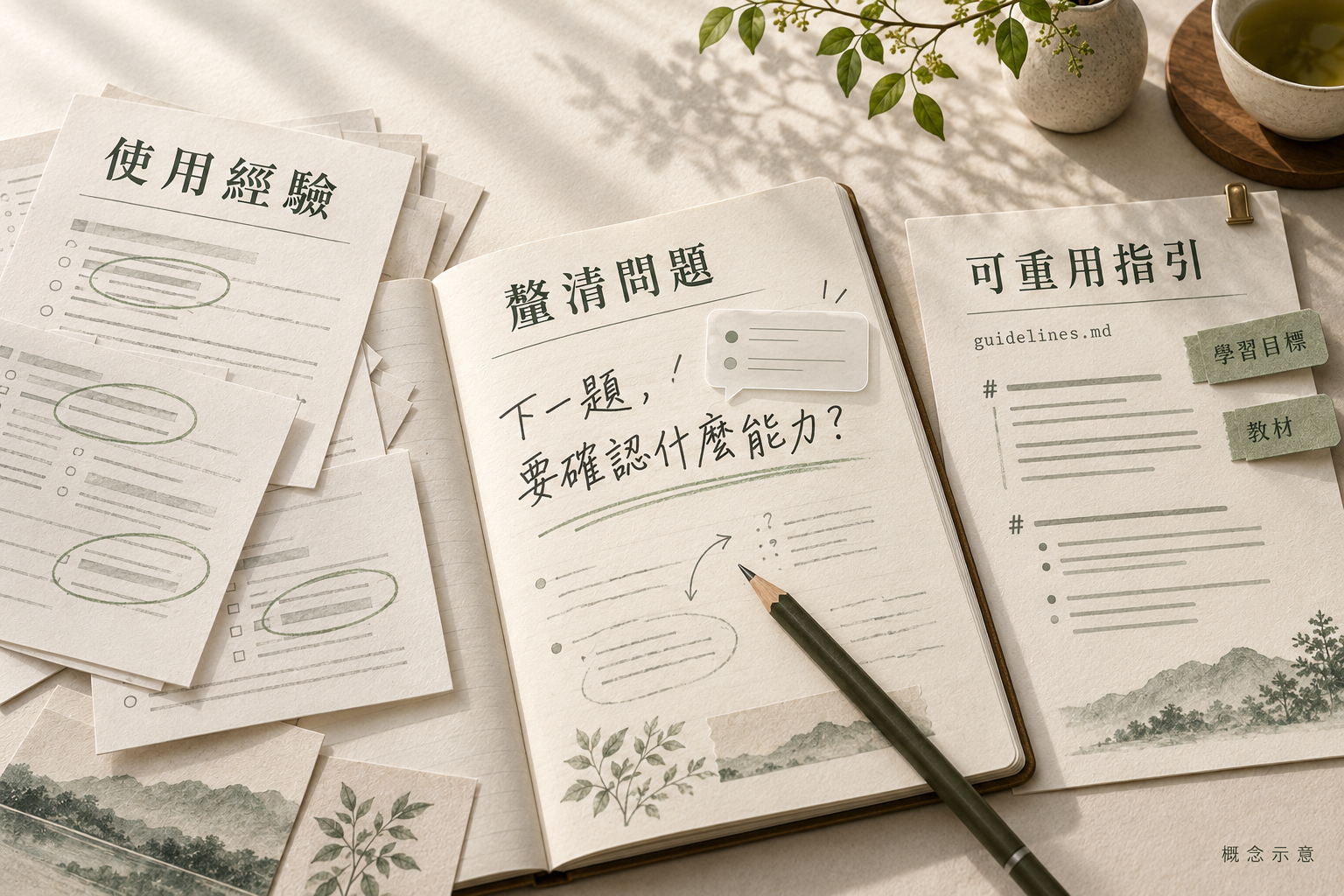
Turning conversational practices into explicit agreements
Asking ChatGPT to explain, pose questions, and correct answers is already a way to begin learning. Organizing the practices into a repository adds a reference that can be checked repeatedly.
Which materials should guide the work? Are we teaching or testing right now? Has the cause of a wrong answer actually been established? What progress needs to be retained when moving to a new conversation? Things that once required repeated reminders in conversation can be written down and revised one by one.
The documents distinguish three conversation modes for different needs:
- Teaching: build concepts and support understanding through explanations and practice.
- Mock exams: check performance against the target scope and difficulty, without continually revealing answers through hints during the test.
- Remediation: address identified gaps and agree in advance on how completion will be judged.
These modes are used as needed; there is no requirement to run through all three each time. Learning and checks can follow the original plan, with remediation when a concrete problem arises. When changing conversations, summarize completed work, answer evidence, and outstanding issues so the next session has a clear starting point.
Learning moves forward, and the method needs revision too
Even after instructions are written down, actual use continues to reveal new problems.
For example, a mock exam may gradually drift away from the intended exam's difficulty. The basis for writing questions needs to be checked; I should not simply have to adapt to increasingly difficult questions. Remediation may also keep retesting with new questions after evidence of meeting the goal already exists. That calls for another look at completion criteria and stopping boundaries.
These experiences led me to see iterative improvement on two levels. One is adjusting the next learning content based on answers. The other is using experience to examine whether the way learning is organized makes sense in the first place.
ChatGPT helps me organize problems and propose revisions. I then return to the actual context of use to judge which rules to keep and which to change. The repository leaves room for continued adjustment for that reason.
Start with a small piece of learning
If you also use AI to learn, you can begin with a short section of material rather than planning an entire course at once.
Prepare a learning goal, trustworthy reference materials, and the time you can spend, then follow the README to get started. Alongside whether answers are correct, observe whether the conversation stays focused on the goal, whether feedback has a basis, and whether you know what you have completed and what comes next at the end of the session.
The public release is currently an alpha consisting mainly of written guidelines. Users still need to provide materials, check feedback, and carry handoff content when switching conversations. The six months refer to the exam-preparation experience behind these methods; they do not mean the public release has undergone six months of effectiveness validation.
I made the project public to turn this process of exploring with ChatGPT into a starting point others can understand, try, and modify. For me, writing the methods down also provides a reference for the next improvement.